
In-House Dental Lab vs Outside Lab: What Changes for Your Crowns, Veneers and Implant Teeth
Who makes your crowns matters as much as who places them. How an in-house CAD/CAM lab changes fit, timing and accountability for dental work in Panama.
When you compare dental clinics abroad, you compare prices, reviews and the dentist. Almost nobody asks the question that decides how your new teeth fit, look and last: who actually makes them? In most clinics the answer is an outside lab you will never see. At Panamá Sonríe it is our own lab, working with our dental team since 2007.
- Crowns, veneers and implant bridges are made in a dental lab, not in the dental chair. In many clinics that lab is an outside company.
- Our lab is in-house: we design and mill zirconia and lithium disilicate with CAD/CAM and finish each piece by hand, next to the dentist who treats you.
- It makes 300 to 500 ceramic crowns and veneers a month, plus more than 300 removable dentures a month, for our patients and for other clinics.
- For a patient who travels, an in-house lab means faster adjustments, fewer surprises and one team accountable for the result.
What is an in-house dental lab?
An in-house dental lab is a laboratory inside the clinic, where technicians design and make your crowns, veneers, bridges and dentures next to the dentist who treats you. Most clinics send impressions or scans to an outside lab and wait days for the work to come back. With an in-house lab, design, fabrication and try-in happen under one roof.
That difference sounds technical, but you feel it in the chair: when a crown needs a change in shape, shade or bite, the person who made it can see it in your mouth the same day, instead of reading a note sent by courier.
How does CAD/CAM work in a dental lab?
CAD/CAM means computer-aided design and computer-aided manufacturing: your teeth are scanned, the restoration is designed on a computer, and a milling machine carves it from a solid block of ceramic. In our lab we mill zirconia, sinter it in-house, and then layer and characterize the ceramic by hand so it looks natural.
The workflow, step by step:
- Digital record. Our Shining 3D Aoralscan Elite intraoral scanner captures your teeth, and the MetiSmile facial scanner records your face and how you move when you bite. Photos and, for implants, a CT scan complete the record.
- Design. Our team designs each tooth on the computer. For smile makeovers we use exocad, the software that lines up your smile photos with your scan.
- Milling and printing. The design is milled from zirconia or lithium disilicate. Models and other pieces are printed on our AccuFab-CEL 3D printers and cured in a FabCure 2 unit.
- Sintering and firing. Zirconia is sintered to reach its final strength; ceramics are fired.
- Hand finishing. A technician layers, stains and glazes the piece for shape, translucency and texture.
- Try-in and adjustments, with the technician and the dentist working together.
Machines make the work precise and repeatable. Hands make it look like a tooth. Beyond CAD/CAM, we also make hand-layered feldspathic ceramic, pressed (injected) IPS e.max, and ultra-thin “no-prep” veneers for ideal patients, waxed by hand. Our master ceramist, Esteban Pulido, leads that hand work.
Why the scan is where the fit begins
A lab can only be as precise as the digital copy it receives. If the scan is off, the crown is off. Not all scanners are equal: new entry-level models cost from about US$7,000-12,000 at U.S. distributors, while the Aoralscan Elite costs about US$20,000-24,000 in the U.S., depending on the version [5], [6]. We started with a scanner of about US$4,000. Moving to one of about US$20,000 changed our speed and fidelity: fewer rescans, sharper margins and a better fit on the first try.
The Aoralscan Elite also includes photogrammetry, which matters for full-mouth teeth on implants. It records each implant's position with a high-precision photographic technique. In a 2025 review of 13 studies, photogrammetry was more accurate than standard intraoral scanning in 10 of them [3], and a 2026 review reached a similar conclusion [4]. Most studies were done in the lab, so we say it with caution. For you, a more accurate record helps the bridge seat without stress on the implants.
Why does an in-house lab matter if you travel for dental work?
Because your time in Panama is limited, and every adjustment that has to travel to an outside lab costs days. With the lab in the same building, a shade or shape correction can often be made during your stay. The same team designs, makes and checks your work, so nobody can blame "the lab" if something is off.
What changes for you:
- Timing. No courier, no waiting in another company's queue. That is why some cases can be done in 24 hours, such as same-day crowns and bridges or a smile in 24 hours, others in 5 days, and complex cases ideally in 7-10 days, always after studying your case. The ideal timing depends on your case; that's why we first do a proper study of it.
- A delivery date we can keep. Because the lab is ours, once your evaluation confirms you are a candidate, we commit to the delivery date agreed in your treatment plan.
- Fit. The technician sees your bite, your gums and your face, not only a model. Small details, like how a crown meets the gum, are what keep food and bacteria out.
- Esthetics. Shade and shape can be checked with you in the chair and corrected the same day when possible.
- Accountability. One team, one responsibility. It is a big reason we can give every patient a written warranty of 2 years on fixed work (and 1 year on removable dentures).
- Price. No third-party lab margin on top of your treatment. It is one of the reasons our prices are lower than in the U.S. without using cheaper materials.
Does an in-house lab use the same materials as U.S. clinics?
Yes. Our crowns and veneers are made of multilayer zirconia, digitally designed and milled in our own lab, or Ivoclar IPS e.max lithium disilicate, the same families of materials used by good U.S. clinics, and our implants are original MIS (Dentsply Sirona group). The saving comes from lower overhead and no outside-lab margin, not from cheaper materials.
Material is where cheap offers usually cut. Good-quality zirconia costs 300-400% more than a generic one.
How we choose between them:
- Lithium disilicate (IPS e.max): our first choice for veneers and front teeth, where translucency and a natural look matter most. See zirconia vs lithium disilicate veneers.
- Zirconia: very strong. We use an ultra-translucent zirconia for crowns and a high-strength multilayer zirconia for full-mouth implant bridges such as All-on-4 and All-on-6, layered by hand where esthetics matter. Why we use zirconia and not acrylic for those bridges: zirconia vs acrylic implant bridges.
- Flexible dentures: TCS Unbreakable. We are TCS distributors in Panama.
A real case: a patient's veneers, more than five years later
This is a real patient who also collaborates with our lab. He wanted a better smile without going back to braces, so we stayed as conservative as possible with eight lithium disilicate veneers made in our lab. It was a case of medium-to-advanced complexity.
More than five years later, his gums are healthy and the veneers are still well sealed, which we verified with X-rays. You can watch his testimonial on YouTube (English version available) and see his case on our veneers page.
Every case is different, and results depend on your clinical evaluation. We publish cases only with the patient's authorization.
How big is the Panamá Sonríe lab?
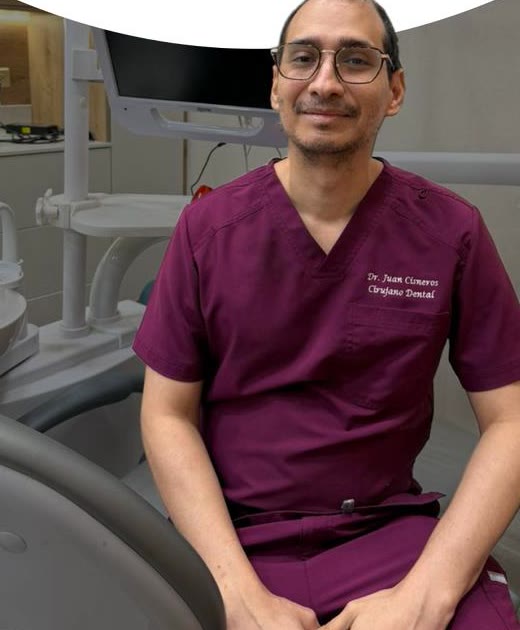
Our lab makes 300 to 500 ceramic crowns and veneers a month, plus more than 300 removable dentures a month (more than 200 of them flexible), for our patients and for other clinics. It works under the supervision of our Medical Director, Dr. Juan Cisneros, who was a dental technician before becoming a dentist. It has worked with our dental team since 2007, and our technicians are certified TCS Unbreakable instructors who train other technicians.
That volume matters for one reason: practice. A lab that makes hundreds of pieces a month sees every kind of bite, shade and complication, and the same team that plans your case checks every piece before it is cemented. If a case cannot be done well, we tell you before we start.
What should you ask any clinic about its lab?
Ask four questions: who makes my crowns, where, with which materials, and who is responsible if they fail. A clinic that answers clearly, names its materials and puts its warranty in writing is a safer choice than one that only quotes a low price. These questions apply in Panama, Costa Rica, Mexico, Colombia or at home.
- Is the lab in-house or outside? If outside, where?
- Which materials and brands will be used for my crowns, veneers or implants?
- Can adjustments be made during my stay, or do they travel to the lab?
- What does the written warranty cover, and who pays for a remake?
General information, not a diagnosis. Your case is confirmed with a clinical evaluation. Reviewed by Dr. Juan Cisneros, Medical Director, Panamá Sonríe.
Let's talk about your case
See what our lab can do for you. Contact us here or call us free: +1 (877) 373-6040. Your video evaluation is free, with no commitment, and you can browse real work from our lab. You can also write to us on WhatsApp: +507 6140-5700.
Keep reading
Frequently asked questions
What is an in-house dental lab?
It is a dental laboratory inside the clinic, where technicians design and make crowns, veneers, bridges and dentures next to the dentist who treats you. Most clinics send work to an outside lab. With an in-house lab, design, fabrication and try-in happen under one roof, so adjustments are faster.
Are CAD/CAM crowns as good as handmade crowns?
A well-designed CAD/CAM crown is precise and consistent, and the best results combine both: the crown is designed and milled by computer, then layered, stained and glazed by hand for a natural look. At Panamá Sonríe every crown and veneer is finished by a technician in our own lab.
Why are crowns cheaper in Panama if the materials are the same?
Because the saving comes from lower overhead and no outside-lab margin, not from cheaper materials. At Panamá Sonríe we use zirconia and Ivoclar IPS e.max lithium disilicate, mill them in our own lab, and quote in U.S. dollars, so there is no exchange rate either.
Can an in-house lab make my crowns faster?
Often, yes. With no courier and no outside queue, design, milling and adjustments happen in the same building. That is what makes express options, such as a same-day crown, possible at Panamá Sonríe, always subject to clinical evaluation and to reserving your spot in advance.
What materials does your lab use?
Zirconia, milled and sintered in-house, mainly for back teeth, bridges and full-set implant bridges, and Ivoclar IPS e.max lithium disilicate, mainly for veneers and front teeth. Our implants are original MIS, part of the Dentsply Sirona group.
Sources (checked November 11, 2026)
- Ivoclar, IPS e.max lithium disilicate (manufacturer information): https://www.ivoclar.com/
- MIS Implants Technologies (Dentsply Sirona group): https://www.mis-implants.com/
- exocad, dental CAD software: https://exocad.com/
- [3] Pozzi A, Arcuri L, Carosi P, et al. Photogrammetry versus intraoral scanning in complete-set digital implant impression: a systematic review and meta-analysis. Clin Implant Dent Relat Res. 2025;27(3):e70059. doi:10.1111/cid.70059
- [4] Jain S, Daak HA, Someli LA, et al. Accuracy of stereophotogrammetry technique versus intraoral scanners for complete-set implant digital impressions: a systematic review and meta-analysis. Eur J Dent. 2026;20(1):34-48. doi:10.1055/s-0045-1806935
- [5] Shining 3D, "New product: Aoralscan Elite" (manufacturer, 10 Sep 2024): shining3ddental.com. U.S. reference prices: Roe Dental Lab, Starcona.
- [6] Institute of Digital Dentistry, Aoralscan Elite launch; entry-level reference: Medit i600, Proto3000.
- Panamá Sonríe, our cases (real lab photos), veneers in Panama; the patient's testimonial: https://youtu.be/sLUH_BDG47w and Warranty.
Scanner prices are public market references, not our treatment prices. General information; it does not replace a clinical evaluation.